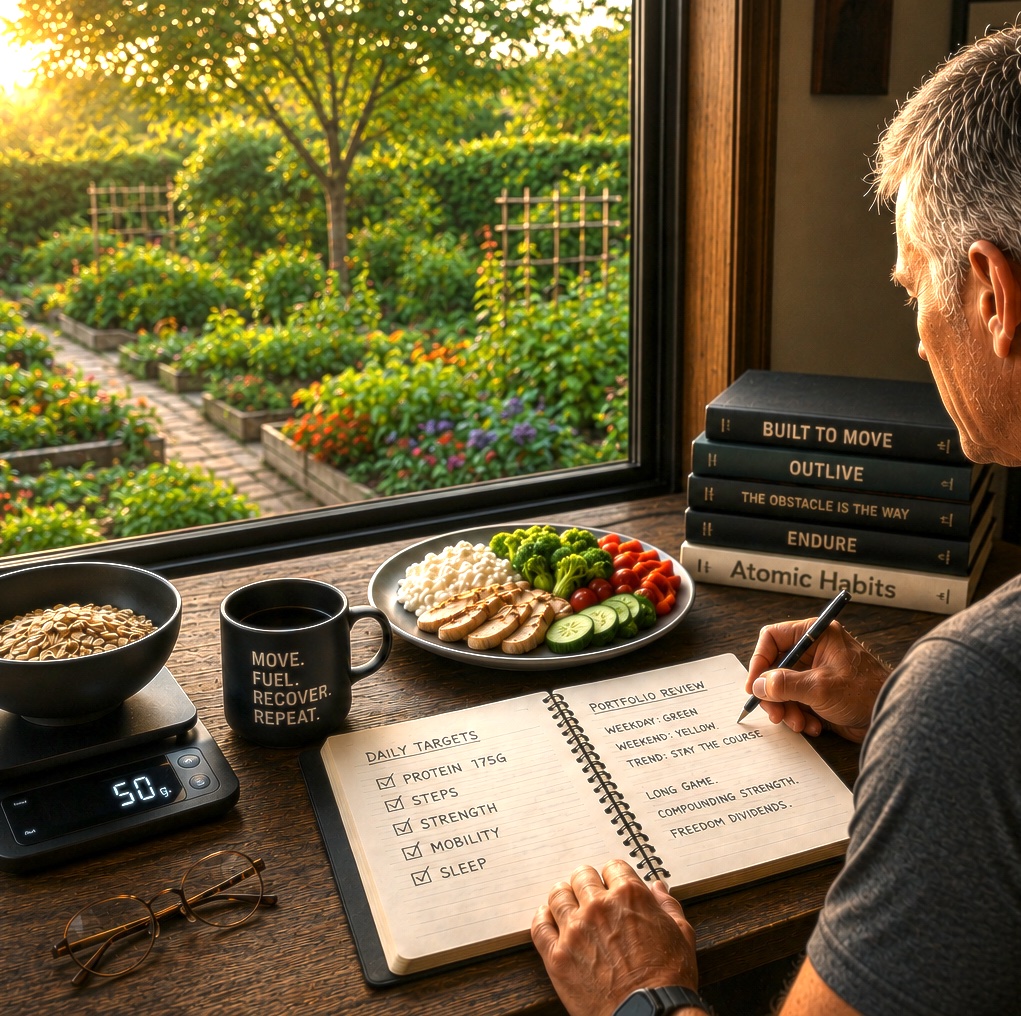
It started, as most things do in this chapter, with a decision that felt reasonable at the time.
I was somewhere around month twelve of retirement, just into 60, feeling softer than I had ever been and slower than I expected to feel.
So I made a decision.
I was going to take my health seriously.
Not diet seriously. Not lose-fifteen-pounds seriously. Build something seriously.
Muscle, specifically.
Not for vanity. For longevity. For what my trainer Cathy calls health currency — the physical reserves that let me live on my own terms at 75, 80, and further if I am paying attention.
I understood the idea intellectually.
Muscle matters. Strength and mobility come with it. The body I build now is the one I will have to negotiate with later.
In financial terms, muscle is an asset. It pays dividends for decades. The best time to build it was twenty years ago.
The second-best time was when I finally stopped pretending I had unlimited runway.
That is how I became a person who reads nutrition labels at the grocery store.
That is how I came to own a food scale.
That is how I ended up comparing protein powders and reading labels like quarterly reports.
That is how the project began.
Not dramatically. Not overnight. Just one measured decision at a time.
Here is what no one really tells you about getting serious about your health at 60.
The shift was subtle at first. The information stacked up. And at some point, you catch yourself out in the real world thinking differently.
An evening out. A menu in front of you.
You are calculating the protein content of a piece of chicken while negotiating internally about whether the steak is worth the hit.
You do not announce it.
But it is there.
I started tracking my food. Thanks to apps.
Daily calorie targets. Macro breakdowns. A running tally I check the way I used to check the market.
What is my position? Am I up? Am I down?
My protein target is 175 grams a day. On a good weekday, I hit it. I know exactly which foods carry the best return.
Greek yogurt. Eggs. Cottage cheese. Chicken.
The blue-chip holdings of the nutrition world. Reliable. Unglamorous. They just show up and do the work.
Then the weekend comes.
I instinctively know the portfolio will take a hit.
The question is how hard of a hit will it be?
Wine and ice cream are my kryptonite.
Not occasionally. Consistently.
Friday night, the wine shows up and the edges soften. Saturday, it is easier to say yes again. And somewhere in there, ice cream shows up.
It is just enough to matter.
But here is what I have learned: the weekend is a recurring negotiation.
And I do not always win it.
Part discipline. Part experience. Part knowing when to push and when to let the scene play.
Some weekends I manage it. Some weekends I don't.
I do not walk into it blind anymore. I walk into it like a line producer trying to close a deal.
Where are the concessions? Where is the overage? Who approved the second glass? What actually matters here?
It does not break the strategy. It just means I have to be honest about it.
Adjust where I can. Compensate during the week. Watch the trend line. Stay in the game.
The food scale, I will admit, took some getting used to.
It sits on the kitchen counter now like a small, judgmental appliance.
I weigh my oats. I weigh my chicken.
I once weighed what I thought was a reasonable serving of pasta, discovered what a serving actually looks like, and had a moment of genuine silence.
No one prepares you for the pasta moment.
Getting serious about my health at 60 is one of the strangest projects I have ever taken on.
The returns are real, but slow. The metrics matter. So does the meal I did not track.
The discipline is useful. And ridiculous at the same time.
I have more muscle than I had at 35. My doctor is pleased.
But the real change is not the protein.
The real change is that I no longer think of health as something I will get around to when life settles down.
Life has settled down.
This is the chapter.
And health is not optional in retirement. It is the system that makes everything else possible.
And if I want to travel, walk beaches, lift suitcases, climb stairs without negotiating, play with grandchildren, get off the floor without making sound effects, and keep saying yes to the life I spent forty years earning, then health cannot sit in the background as a vague intention.
It has to become part of my operating system.
Not obsession. Not perfection. Not turning every dinner into a spreadsheet.
Just enough attention to keep the future from shrinking faster than it has to.
At some point, I realized I was not trying to be impressive.
I am no longer pretending the body will take care of itself just because I am finally free from work.
That is the return I am after.
Not a perfect body. Not a perfect score.
Enough strength in reserve to keep living off the dividends.